Smart Emergency Call Handling for Delmarva Service Teams
Learn how small service businesses on the Delmarva Peninsula can improve after-hours emergency call handling using practical AI strategies to reduce stress and improve customer response.
By Delmarva AI · July 2, 2026
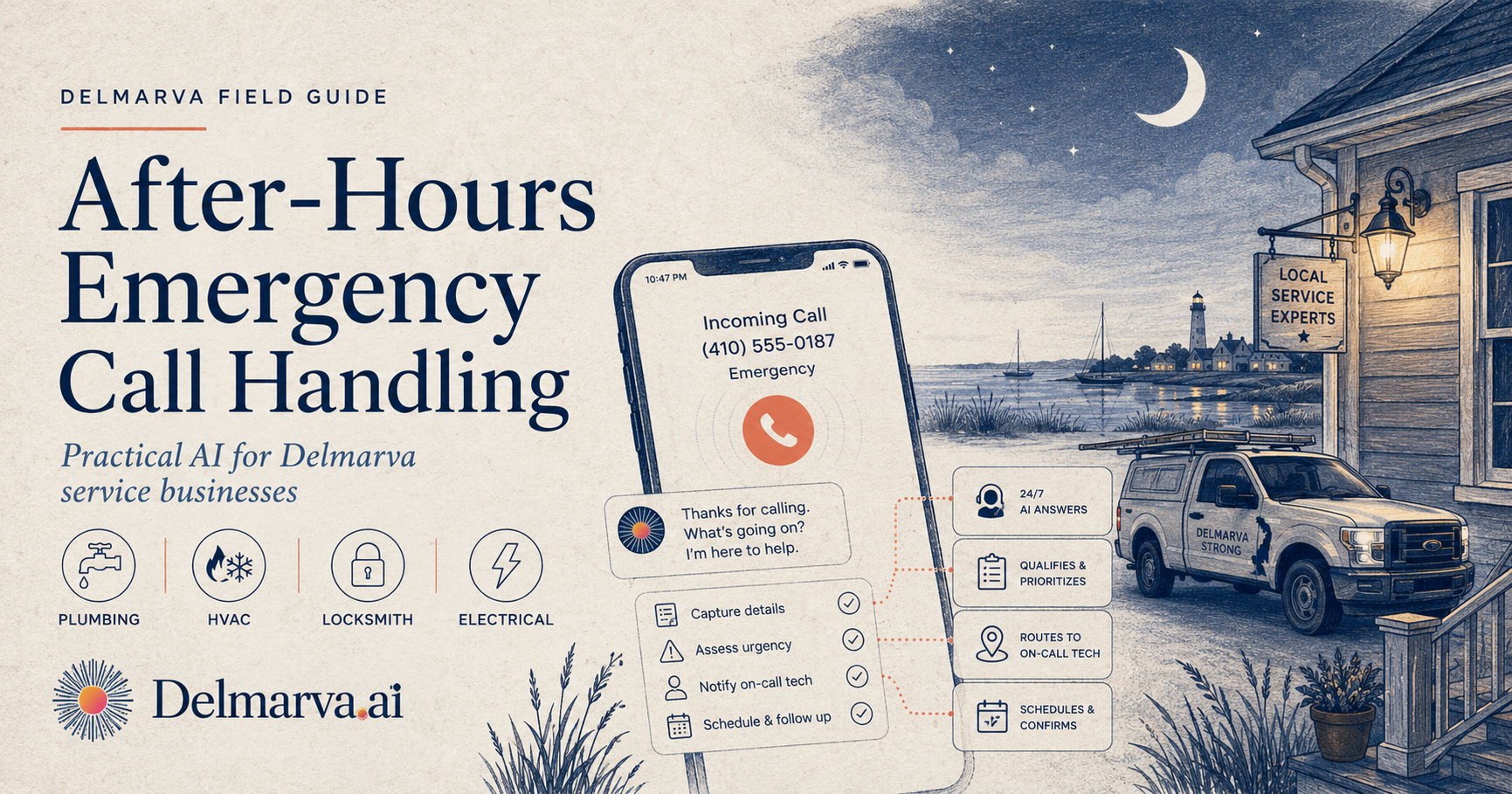
The summer crowds have thinned, but the work never stops for Delmarva service businesses. When a pipe bursts at midnight or a key breaks after hours, your customers expect a plan, and you need a way to deliver without burning out your team. This is where smart, practical approaches to emergency call handling can make a real difference.
The Midnight Call Dilemma
For small businesses on the Peninsula, being "always on" can feel like a badge of honor, but it's also a recipe for stress and burnout. An emergency call isn't just an interruption; it's a critical moment that defines your customer's perception of your reliability. Missing calls, delayed responses, or exhausted staff ultimately hurt your bottom line and reputation.
Traditionally, handling these calls meant rotating on-call shifts, using answering services, or simply hoping for the best. Each approach has its drawbacks: high costs, impersonal service, or inconsistent follow-up. Today, there are practical, accessible ways to integrate technology, specifically AI-powered tools, to smooth out this process without requiring a computer science degree.
Smart Tools, Not Sci-Fi
When we talk about "AI," don't picture robots taking over your business. Think of smart software designed to do specific, often repetitive, tasks more efficiently. For emergency call handling, this means tools that can filter, prioritize, and even respond to common issues, freeing your human team for what they do best: solving problems that truly require their expertise.
Intelligent Answering Services
Forget the old-school answering service that just takes a message. There are now services that use natural language processing (NLP) to understand what a caller is saying. They can:
- Ask qualifying questions: "Is anyone injured?" "What specific appliance is involved?"
- Prioritize calls: A leaking toilet is different from a burst pipe. The system can flag critical issues for immediate human dispatch.
- Provide basic information: "For non-emergencies, our office opens at 8 AM. emergencies, please hold."
- Integrate with your calendar: Automatically schedule a follow-up call or dispatch a technician based on their availability.
These services act as a smart first line of defense, filtering out non-emergencies and gathering crucial details before a human even picks up the phone.
AI-Powered Chatbots for Your Website
Many "emergencies" that come through at 2 AM could be solved with a quick link to an FAQ or a clear explanation of your after-hours policy. A well-designed chatbot on your website can handle these inquiries.
- Deflect non-urgent calls: "My internet is slow." The chatbot can direct them to typical troubleshooting steps.
- Provide immediate answers: "What's your emergency plumbing rate?" The bot can share pre-approved information.
- Guide to the right contact: If it's a true emergency, the chatbot can direct them to your emergency line or dispatch system.
Setting up a chatbot isn't as daunting as it sounds. Many website platforms offer integrated solutions that you can train with your existing FAQs and service policies.
Automated Dispatch and Notification Systems
Once an emergency is identified, getting the right person on the job quickly is critical. Modern dispatch systems, often enhanced with AI, can:
- Match skills to needs: If your electrician is vacationing in Fenwick, the system knows to notify the next available team member qualified for electrical work.
- Optimize routes: For service businesses with multiple technicians, these systems can suggest the most efficient route, saving time and fuel.
- Automate notifications: Send SMS messages to customers with ETA updates, reducing anxious follow-up calls.
Think of these as smart assistants that make sure the right person knows about the right problem at the right time, with all the necessary details.
CRM Integration for Context
If your business uses a Customer Relationship Management (CRM) system, linking it to your emergency handling process is a smart move. When an emergency call comes in, the system can immediately pull up the customer's history.
- Know their equipment: If you're a HVAC company, knowing their specific furnace model helps the technician prepare on the way.
- See past service issues: Is this a recurring problem? The technician arrives informed.
- Personalized service: Even in an emergency, knowing the customer's name and history can make a big difference in perception.
Watch Out For
While these tools offer significant advantages, it's crucial to approach them with practical caution.
- Data Privacy: You'll be sharing customer information with these tools. Ensure any vendor you choose has robust data security policies and complies with relevant regulations. Ask direct questions about where data is stored and who has access.
- Accuracy Limits: AI tools aren't perfect. They excel at repetitive tasks and structured data but can falter with nuanced situations or unusual requests. Always ensure there's a clear escalation path to a human for complex issues. Don't rely solely on automated systems for critical decisions.
- Vendor Lock-in: Be mindful of contracts and data portability. Can you easily switch providers if a service isn't meeting your needs? Ensure your customer data remains yours and isn't trapped within a proprietary system.
- "Set and Forget" Mentality: These tools require ongoing monitoring and occasional adjustments. Customer needs evolve, and your responses should too. Don't assume that once set up, they'll work perfectly forever.
Practical Benefits for Delmarva Businesses
Implementing these strategies isn't about replacing people; it's about empowering them.
- Reduced Stress: Your team gets more uninterrupted sleep and can focus on quality work during business hours.
- Faster Response Times: Critical issues are identified and dispatched more quickly.
- Improved Customer Satisfaction: Customers feel heard and helped, even after hours, leading to greater loyalty.
- Cost Savings: While there's an initial investment, the reduction in overtime, missed calls, and potential client loss often outweighs the cost.
- Better Data: These systems log interactions, providing valuable insights into common emergency issues and peak times, allowing you to proactively improve your services.
For a local business, your reputation is everything. Handling emergencies smoothly, efficiently, and with care helps solidify that reputation and ensures your customers keep coming back, season after season.
What To Do This Week
- Audit Your Current Process: Write down exactly how an emergency call is handled from the moment it comes in until it's resolved. Identify bottlenecks and pain points.
- Define "Emergency": Clearly list what constitutes an after-hours emergency for your business, and what can wait until morning. Share this with your team and eventually, your customers.
- Research Smart Answering Services: Look into services that offer AI-powered call qualification and prioritization. Ask for local references if possible.
- Explore Website Chatbots: Check your website platform for integrated chatbot options. Start simple by programming answers to your most common after-hours questions.
- Talk to Your Team: Get their input on current challenges and potential solutions. Their insights are invaluable for successful adoption.
If you need help accomplishing any of this, we can help by building it for you-we're just a click away.
Want this applied to your business?
Get a short written AI Readiness Review for your workflows, tools, and first 30 days.
Get the next one in your inbox
The Delmarva AI Brief — one short email, practical AI you can use this week.