Too Much, Too Fast: Why Your Business Is Stuck in Place
Trying to implement every new idea at once often halts progress. Learn why focusing your efforts is crucial for moving your Delmarva business forward.
By Delmarva AI · July 21, 2026
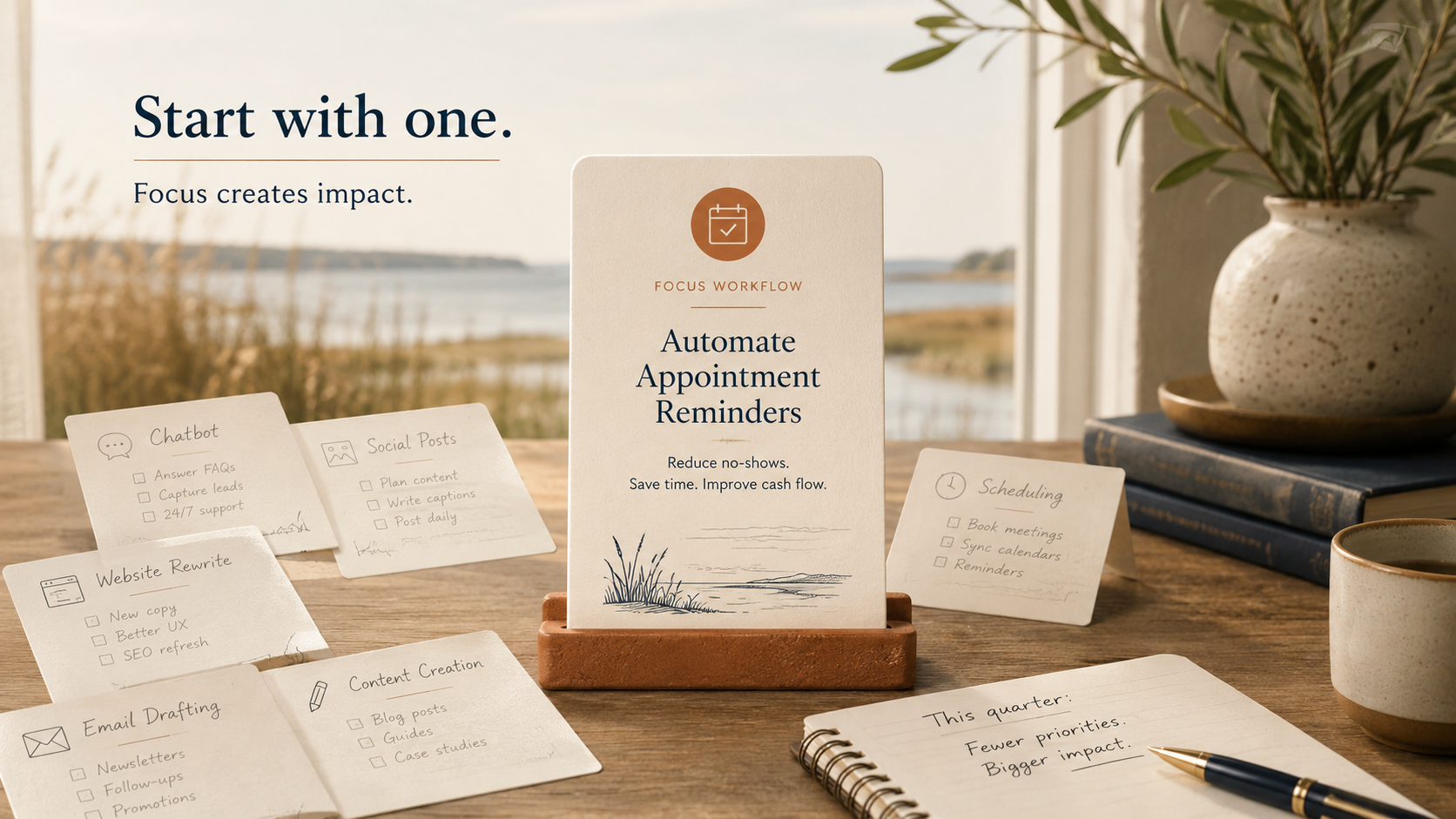
It’s that time of year on Delmarva, between the quiet of winter and the full-on rush of summer. Your to-do list for getting the business ready is a mile long, and now there’s a new item on it: “Figure out this AI stuff.” You see the headlines and hear the talk, and you feel like you need to be doing something, anything, to keep up.
This pressure leads to a common problem. We try to do too much, too fast. We simultaneously try to build an AI chatbot for the website, use an AI to generate social media posts, and get an AI to re-write all our service descriptions. The result is almost always the same: nothing gets finished. Progress grinds to a halt.
The Cost of "Everything, Now"
When you spread your attention and resources across a dozen new, unfamiliar projects, you’re not moving forward. You’re just creating a lot of motion. For a small business owner in Sussex County or on the Eastern Shore of Maryland, this isn't just inefficient; it's expensive in terms of time and lost focus.
The Pilot Program Graveyard
This pattern is predictable. You get an idea on Monday to use an AI writing assistant to create new property descriptions for your real estate listings. You spend a few hours getting it set up and run a few tests. On Wednesday, you read about an AI scheduling tool that could help book client meetings or contractor estimates. You jump over to that, spending the afternoon trying to make it work.
By Friday, you have two half-finished projects, neither of which is actually helping your business. Your team is confused about which tool to use, and you're back to writing property descriptions the old way because it's just faster than dealing with the half-implemented new system. Your business becomes a graveyard of well-intentioned pilot programs.
Employee Whiplash
If you have a team, even a small one, this approach is frustrating for them. One week they are told to use a new system for drafting customer emails. The next week, that system is abandoned for a different tool that’s supposed to manage project timelines.
This constant shifting prevents anyone from becoming proficient. It breeds skepticism. Your crew, whether they're on a job site in Wicomico County or serving customers in a Lewes restaurant, learns to just wait it out, assuming the new "big idea" will be gone by next month.
No Real Wins
The most significant cost is that you never actually see the benefit. By spreading your efforts an inch deep and a mile wide, you don't solve any single problem completely. An AI scheduling assistant, properly implemented, can save a busy contractor hours each week. An AI writing tool, properly learned, can help a tourism operator create event descriptions for a whole season in a single afternoon.
But if you only get them 20% of the way set up before chasing the next shiny object, all you've done is add another password to your list and another subscription to your credit card bill.
The Power of One Problem, One Solution
The alternative is simple, but it requires discipline. Instead of a dozen initiatives, pick one.
Look at your business and ask a direct question: What is the single most repetitive, time-consuming task you or your team does every week? Not a complex strategic challenge, but a bottleneck. A recurring annoyance.
- For the contractor: Is it manually typing up the same scope-of-work details for every new quote?
- For the real estate agent: Is it staring at a blank page trying to write the first draft of an MLS description for a standard three-bedroom home?
- For the restaurant owner: Is it responding to the same five questions (“Do you take reservations?” “Are you dog-friendly?”) on social media every single day?
- For the professional services provider: Is it the endless back-and-forth emails just to find a 30-minute meeting time?
Once you identify that single problem, find a single category of tool that addresses it.
- That quoting bottleneck? Look into AI writing assistants that can store and recall templates for you.
- That blank page for the MLS? An AI writer can generate a solid first draft in 30 seconds for you to edit.
- Those repetitive social media questions? A simple AI chatbot designed for social media can handle those for you.
- That scheduling nightmare? A scheduling assistant like Calendly or Acuity can solve it completely.
Focus all your energy on implementing that one solution until it is fully integrated into your workflow and is saving you measurable time. Then, and only then, should you move on to the next problem.
Watch Out For
Adopting any new tool requires a healthy dose of Delmarva skepticism. Keep these points in mind.
Data Privacy: Never paste sensitive customer information into a public AI tool. This includes names, addresses, phone numbers, or any private details from a client conversation. Treat your AI inputs like a postcard—don't write anything on it you wouldn't want a stranger to read.
Accuracy Limits: AI tools, especially for writing, can "hallucinate" or make things up. Always fact-check what they produce. If you ask an AI to write a description of Fenwick Island, it might invent a historical fact or misstate a local detail. You are the expert. The tool is just an assistant. The final work is your responsibility.
Vendor Lock-In: Be wary of building your entire business process around a single, complex, and proprietary AI platform. The more you rely on one company's specific system, the harder it is to leave if they raise prices or change their service. Favor simpler, more focused tools that do one job well. They are often easier to replace if needed.
What To Do This Week
Stop thinking about a dozen AI strategies. Focus on one concrete action.
- Identify the Annoyance. Write down the single most tedious, repetitive task you did this past week. Be specific. Not "marketing," but "writing captions for three Instagram photos."
- Get a Baseline. The next time you do that task, time yourself. How long does it actually take? Knowing this gives you a clear measure of success.
- Research One Tool Category. Based on your task, spend 30 minutes researching only the category of tool that solves it. If your problem is scheduling, only look at scheduling assistants. Ignore everything else.
- Ask a Neighbor. Talk to one other local business owner about the bottleneck you identified. You might find they have the same problem or have already found a practical way to solve it, with or without a new tool.
Want this applied to your business?
Get a short written AI Readiness Review for your workflows, tools, and first 30 days.
Get the next one in your inbox
The Delmarva AI Brief — one short email, practical AI you can use this week.